 Facebook
 Instragram
 College and Department of Buddhist Studies, FGU


Through monastic community life and sustained Buddha-recitation practice, students experienced the practical and lived dimensions of Buddhist cultivation.
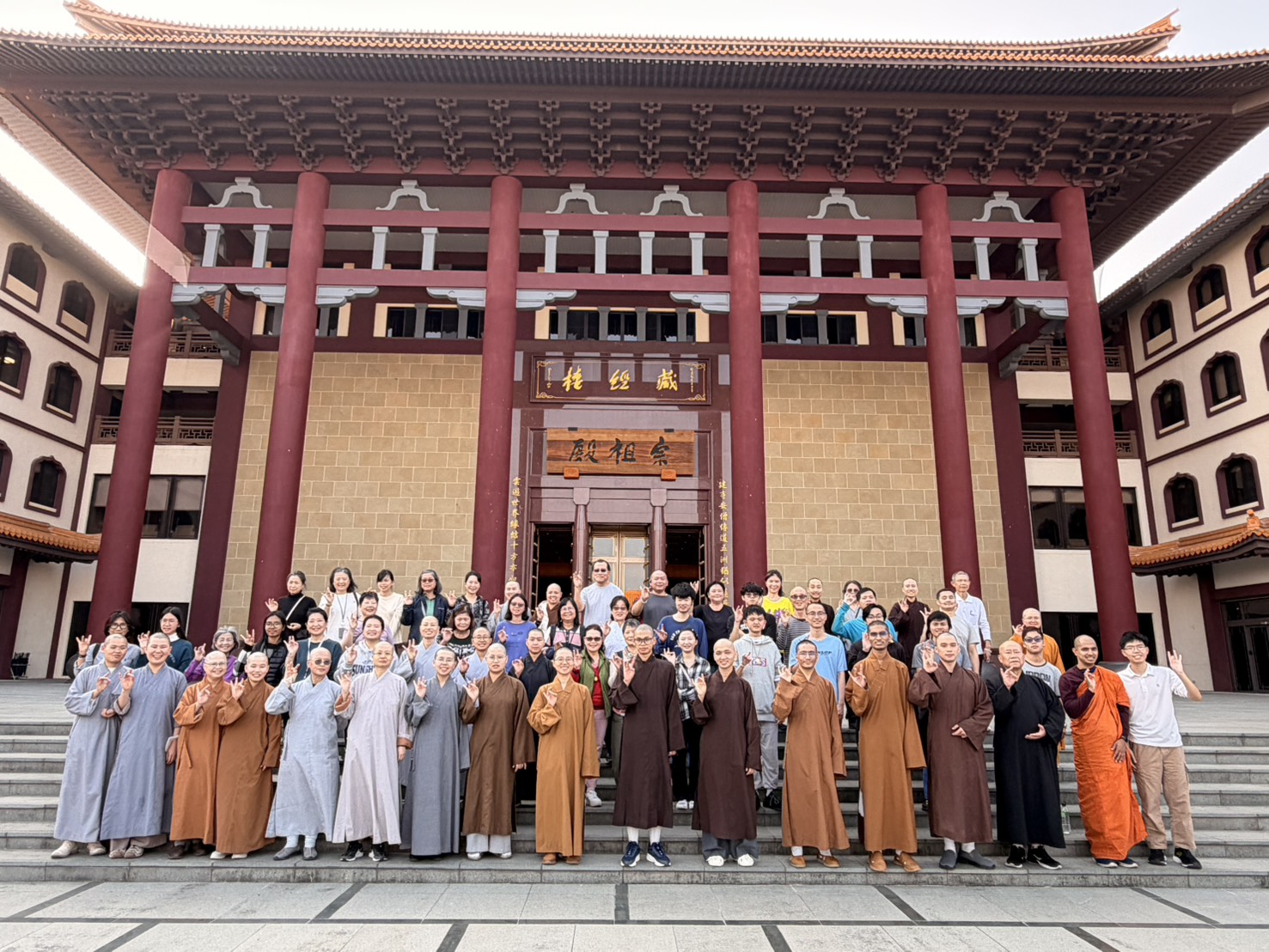
During the retreat, faculty and students paid respects at the Patriarchs’ Hall and received guidance from Fo Guang Shan Abbot Hsin Bao and Fo Guang University Board Chair Tzu Hui.
The retreat was presided over by Jingye Forest Hall Director Yongzang, Retired Abbot Hsin Pei, Deputy Abbot Hui Zhao, and Venerable Huifa of the Fo Guang Shan Buddha Museum.The program integrated Dharma talks with hands-on practice. Monastics offered instruction based on the Avataṃsaka Sūtra – “Chapter on Pure Practices,” on Master Hsing Yun’s daily conduct, and on core methods of Buddhist cultivation. Additional sessions included tea meditation and sutra-copying practice.
Applying Mindfulness in Everyday Life
On January 19, Venerable Miaolin spoke on “Making Skillful Use of the Mind in Daily Life through the ‘Pure Practices’ Chapter of the Avataṃsaka Sūtra.” She explained the scripture’s historical background and emphasized that the text teaches practitioners to apply mindful awareness throughout everyday activities—waking, washing, eating, and resting—thereby cultivating immeasurable merits.
She shared that memorizing this chapter during her Buddhist college years helped her maintain focus amid changing conditions. She encouraged students to develop selflessness and broad-mindedness.
She also noted that Master Hsing Yun’s modern prayers—such as the Morning Prayer, Morning Aspirations, and Bedtime Prayer—can be seen as contemporary vernacular expressions of the “Pure Practices” spirit, helping integrate Dharma into daily life. Quoting Fo Guang Aphorisms, she reminded students that repeated actions become habits and habits shape one’s destiny.
Learning through Environment and Practice
That afternoon, the group gathered at Samantabhadra Hall for tea meditation. Venerable Huikai introduced the hall’s origins, explaining that it is one of Fo Guang Shan’s four major halls, created so that devotees might symbolically “pilgrimage” to China’s four great bodhisattva sacred mountains within the monastery itself.
He further explained the vows and practices of Samantabhadra Bodhisattva as exemplifying diligent, concrete action, encouraging students to put their learning into practice.
Through this Fo Qi retreat, students from diverse cultural backgrounds deepened their experiential understanding of Buddhism and embodied the department’s educational spirit of integrating knowledge and action.
Guidance from Venerable Tzu Hui
Later that day, Venerable Tzu Hui offered further instruction. She explained that the Practice-in-Action curriculum was designed in line with educational policy to combine theory with real-world application. The seven-day retreat, grounded in Pure Land scriptures and treatises, provides tangible benefits for both monastics and lay practitioners.
Through disciplined practice, one learns to regulate wandering thoughts, prevent afflictions from escalating, and cultivate wisdom in daily life and work. Drawing from her own experience at Leiyin Temple, she emphasized the meaning of “single-minded concentration” and the importance of wholesome roots and karmic conditions.
She encouraged students to cherish their studies, noting that the establishment of a comprehensive modern academic system for Chinese Buddhism at Fo Guang University is a rare opportunity—especially at a time when Buddhist scholarship in Taiwan faces generational gaps. Students were urged to commit themselves to the path of Buddhist learning and contribute to the propagation of the Dharma.
The Spirit of “Pu”: Equality and Shared Responsibility
On January 20, students joined the entire monastic community for communal service. Venerable Miaoguang spoke on the meaning of “pu” (universality) in Buddhist monastic life—seen in terms such as communal labor, communal tea, and communal service.
The essence of “pu,” she explained, is equality: everyone works and lives together without distinction of status. Students were encouraged to cultivate this spirit in daily life—caring for others, respecting elders, and thinking from the perspective of the whole community.
Quoting Master Hsing Yun, she reminded them:
When you come to Fo Guang Shan,
look at its substance, not merely its appearance;
look at the community, not just individuals;
look at the system, not isolated cases;
look at its history, not just the present moment.
🔗 Related report: https://reurl.cc/GG2pvd