 Facebook
 Instragram
 College and Department of Buddhist Studies, FGU


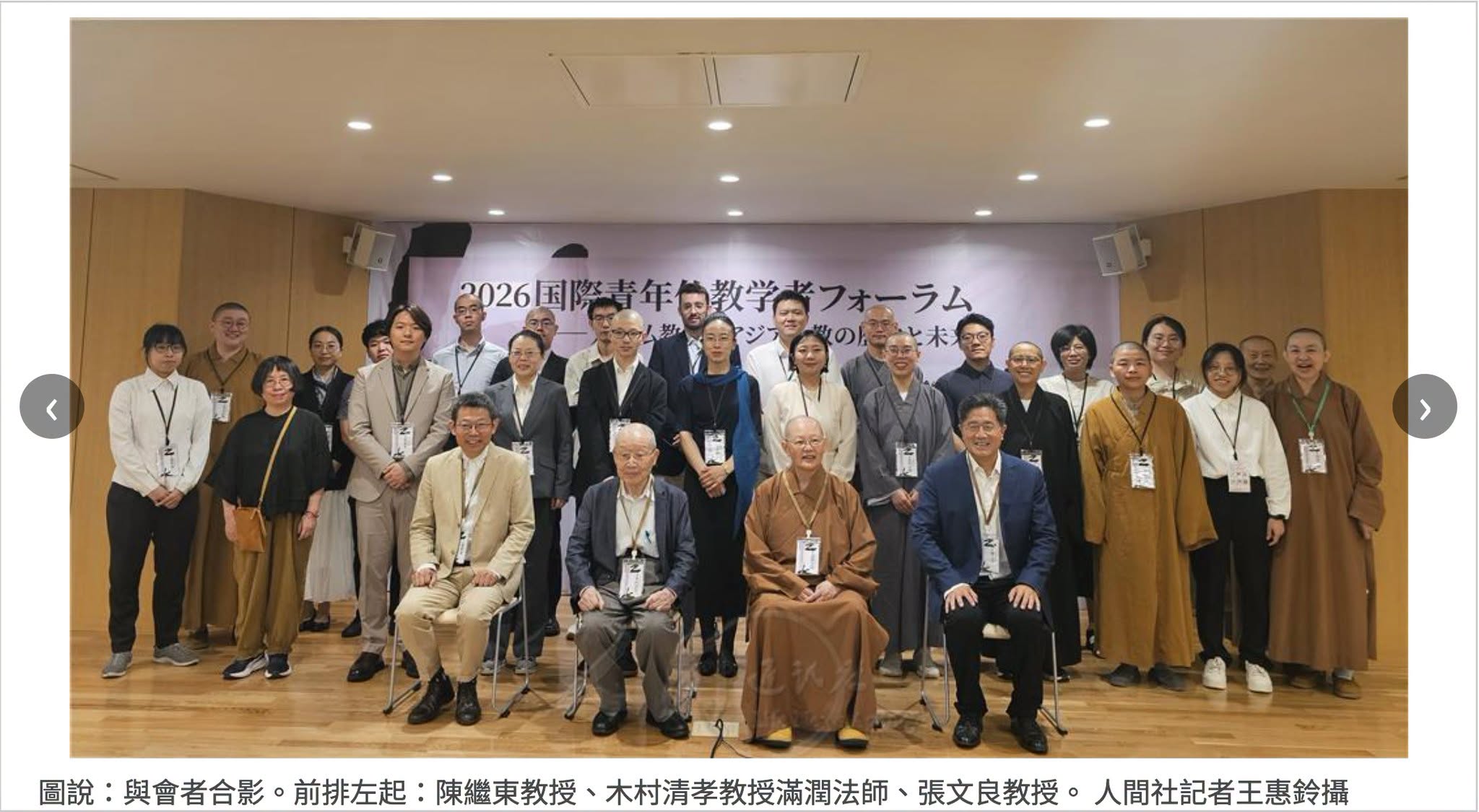
he Second International Forum for Young Buddhist Scholars 2026, titled “Humanistic Buddhism and East Asian Buddhism: History and Future,” was organized by the Fo Guang Shan Institute of Humanistic Buddhism in Japan and held from August 28 to 31 at the Five Contemplations Hall of Fo Guang Shan Fashui Temple. Twenty-four young scholars from Japan, South Korea, mainland China, Taiwan, and other regions gathered for the forum, presenting research papers in Chinese and Japanese. Through scholarly exchange and thematic discussions, participants explored the historical development and future directions of Humanistic Buddhism and East Asian Buddhism.
The forum featured keynote lectures by Kiyotaka Kimura, Professor Emeritus at the University of Tokyo; Makoto Yoshimura, Vice President of Komazawa University; and Daigo Isshiki, Associate Professor at the University of Tokyo. Jidong Chen, Professor at Aoyama Gakuin University, and Wenliang Zhang, Professor at Renmin University of China, served as discussants. Marcus Bingenheimer, Professor at Temple University in the United States, was specially invited to moderate a panel discussion. By bringing together scholars from different generations, countries, and fields of specialization, the forum provided young Buddhist scholars with a diverse and intellectually engaging platform for academic dialogue.
Graduate students from the Department of Buddhist Studies—Bhikṣuṇī Zhiquan, Deng Tingjuan, and Deng Tingyu—also participated in the forum and presented their research papers. Together with young scholars from different countries and regions, they exchanged research findings and contributed to scholarly discussions on Humanistic Buddhism and East Asian Buddhism.
Professor Jidong Chen observed that, after two consecutive editions, the International Forum for Young Buddhist Scholars, whose participants are primarily doctoral students, has gradually developed into a platform that integrates research presentation, academic training, and international scholarly exchange. Particularly noteworthy is the expanding scope of research represented at the forum. In addition to traditional topics in Buddhist thought, history, and textual studies, an increasing number of young scholars are examining the thought, historical development, and contemporary practices of Fo Guang Shan Humanistic Buddhism from the perspectives of Buddhist Studies, history, and cross-cultural studies.
This development, Chen noted, indicates that Humanistic Buddhism is not only an evolving Buddhist philosophy and mode of Dharma propagation but is also increasingly emerging as a significant field of inquiry within contemporary Buddhist Studies.
He further emphasized that, in this respect, the Young Scholars Forum not only helps cultivate a new generation of Buddhist Studies scholars but also contributes to expanding the horizons of contemporary Buddhist scholarship. Its academic value and long-term significance therefore deserve recognition, making the forum an initiative worthy of continued development and support.
Adapted from a report by Xin Ke (心課), Renjian News (人間社), Gunma, Japan, September 1, 2026.