 FGU
FGU

 College and Department of Buddhist Studies, FGU

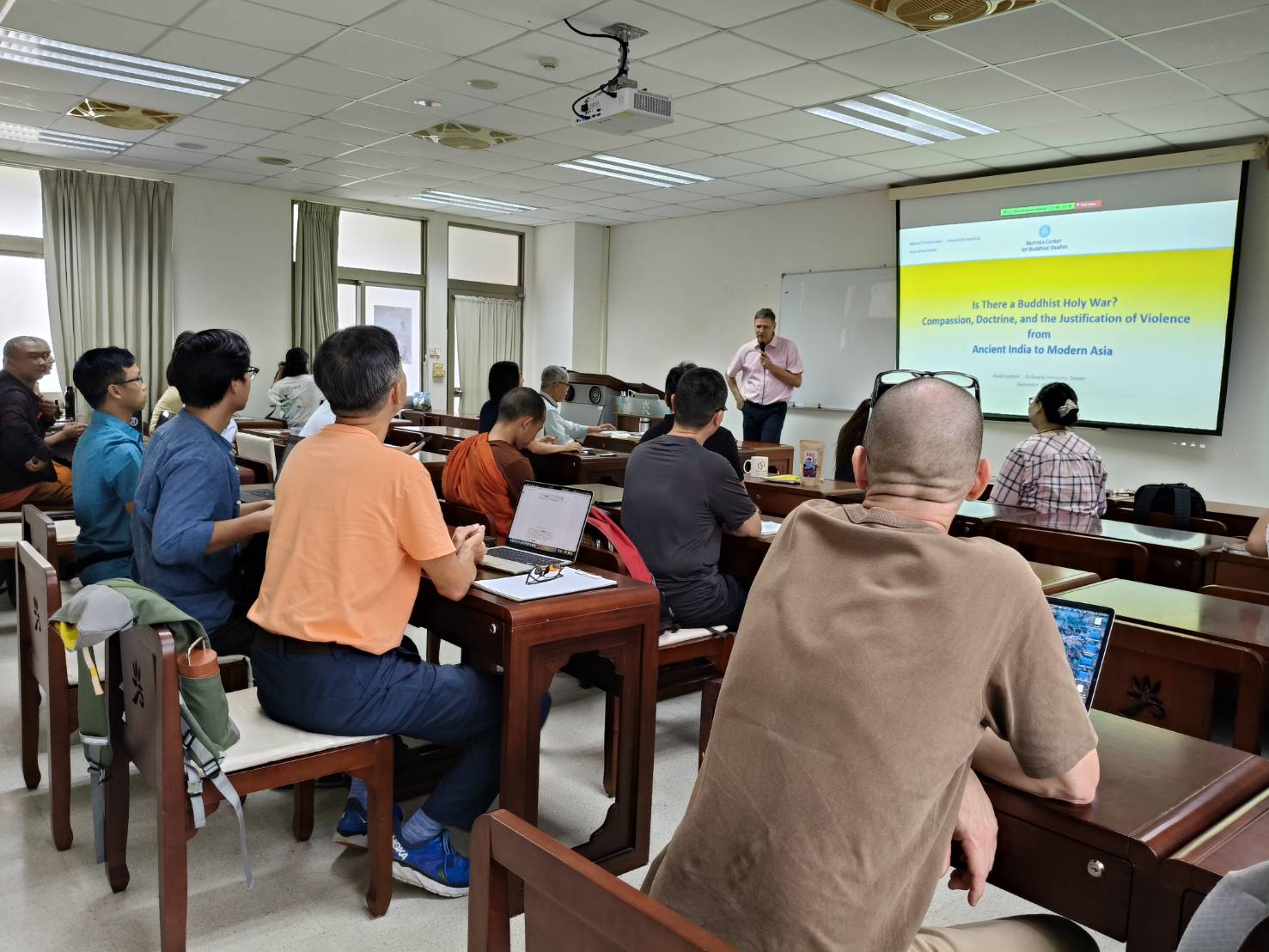
Professor Michael Zimmermann of the Institute of Asian and African Studies and the Numata Center for Buddhist Studies at the University of Hamburg, Germany, was invited to deliver a lecture entitled “Is There a Buddhist Holy War? Compassion, Doctrine, and the Justification of Violence from Ancient India to Modern Asia.” Focusing on whether Buddhism has ever developed a concept comparable to holy war, the lecture examined the complex relationship among compassion, doctrine, and the justification of violence. Its sources ranged from ancient Indian Buddhist scriptures, Buddhist conceptions of kingship, and Mahāyāna and tantric texts to modern Asian Buddhist nationalism and cases of religious violence.
Professor Zimmermann began by considering the Christian traditions of “just war” and “holy war” as a point of comparison. He explained that Christian thought developed theological arguments capable of linking warfare to divine command. Although Buddhism has also interacted extensively with political power—for example, Buddhist ideas of kingship have influenced law and governance in parts of Asia—the central question of the lecture was not simply whether Buddhism had become involved in politics. Rather, it asked whether Buddhism had ever developed a systematic doctrine capable of justifying warfare or even investing it with sacred significance.
Professor Zimmermann then turned to foundational Buddhist ethics, noting that the First Precept prohibits the taking of life. In principle, this prohibition applies even in defensive warfare. Early Buddhist scriptures also condemn killing in war: a warrior who dies on the battlefield with the intention of killing the enemy is said to face rebirth in an unfortunate realm. Nevertheless, when the Buddha interacted with kings frequently involved in warfare, he did not directly apply the precept against killing to questions of royal governance and interstate conflict. Instead, the texts appear to maintain a certain reserve, treating personal ethics and statecraft as distinct spheres. This suggests that Buddhism did not always respond to political realities by applying a single ethical principle in a straightforward manner.
The lecture also addressed pacifist narratives within the Buddhist tradition. Some vamsa literature, for example, portray princes or kings who would rather relinquish their thrones and endure humiliation than preserve their power through violence. Professor Zimmermann emphasized, however, that such narratives do not represent the tradition’s only perspective. Historically, Buddhists could uphold the religious ideal of non-killing while simultaneously engaging in military action in particular social roles, thereby compartmentalizing potentially conflicting values.
At the scriptural level, Professor Zimmermann devoted particular attention to the views of kingship and warfare presented in the Sūtra Spoken by the Great Saccaka Nirgrantha (《大薩遮尼乾子所說經》). Preserved in both Chinese and Tibetan translations, its section on kingship seeks to explain how a righteous king should respond to war. The text first requires the king to make every effort to prevent conflict through benevolence, generosity, acts of kindness, or demonstrations of superior strength. If war remains unavoidable, the king must seek to protect his people, secure victory, and capture enemy soldiers alive whenever possible rather than kill them. Professor Zimmermann suggested that this passage may represent one of the closest approximations to a systematic “just war theory” in Buddhist literature. Its emphasis, however, is on restraint, minimizing bloodshed, and protecting the population, rather than on conquest or expansion.
Professor Zimmermann stressed that the Sūtra Spoken by the Great Saccaka Nirgrantha does not establish a genuine theory of “holy war.” It does not fully articulate just causes for war or the nature of legitimate authority; neither does it associate a warrior’s death with sacred salvation or portray combat itself as holy. Thus, although the text offers a rare Buddhist discussion of the ethics of warfare, it is not equivalent to the concept of holy war found in Christian traditions.
The lecture proceeded to examine several more controversial exceptions in Buddhist literature. Passages concerning icchantikas and the protection of the Dharma in the Mahāparinirvāṇa Sūtra, for example, describe lay Buddhists and even kings carrying swords and spears to defend the true Dharma. The Kālacakra Tantra, meanwhile, depicts an apocalyptic war between the king of Śambhala and non-Buddhist forces and is therefore regarded as one of the Buddhist narratives most closely resembling holy war. Professor Zimmermann noted, however, that later traditions have often reinterpreted the conflict in the Kālacakra Tantra as an inner spiritual struggle rather than a direct call to armed action in the external world.
Professor Zimmermann also analyzed the well-known account in the Bodhisattvabhūmi of a bodhisattva who kills a bandit. In this narrative, the bodhisattva kills the man both to prevent him from murdering the people aboard a ship and to save him from accumulating the grave karmic consequences of such an act. This episode is frequently invoked in discussions of whether killing motivated by compassion can be morally justified. Professor Zimmermann cautioned, however, that this is an exceptional response to an individual situation and is permissible only when grounded in genuinely compassionate motivation. It cannot be generalized into a theory justifying collective warfare.
Turning to modern and contemporary history, the lecture discussed Buddhist nationalism in Sri Lanka and Myanmar. Professor Zimmermann explained that Sinhalese Buddhist nationalism in Sri Lanka has remobilized the Mahāvaṃsa narrative of King Duṭṭhagāmaṇi’s war. In this process, dharma-yuddhaya, which may be understood as an inner spiritual struggle, was transformed into a “Dharma war” situated within the context of actual politics and armed conflict. In Myanmar, the 969 Movement employed numbers symbolizing the Buddha, Dharma, and Saṅgha to mobilize collective identity. Through sermons, media campaigns, economic boycotts, and rumors, the movement constructed a narrative of a Buddhist community under threat. These cases demonstrate that Buddhist violence does not necessarily depend upon a fully developed theological system; it may also emerge through contingent combinations of myth, ethnic identity, conceptions of sacred territory, and modern nationalism.
In conclusion, Professor Zimmermann observed that the Buddhist tradition contains a small number of narratives and doctrinal passages that may be used to justify violence. On the whole, however, Buddhism did not develop a systematic, expansionist theory of “holy war” comparable to the Christian Crusades or traditions of Islamic jihad and directed toward conversion or conquest. Even in the most extreme examples, violence permitted or justified within Buddhist traditions has generally been characterized as defensive, protective of the Dharma, or intended to safeguard others, rather than as an instrument of expansion and conquest.
Through interreligious comparison, scriptural interpretation, and analysis of modern cases, the lecture encouraged faculty members and students to reconsider the tensions between Buddhist ethics of compassion and political violence. It challenged both the simplistic assumption that Buddhism is necessarily peaceful and the equally reductive claim that religion inevitably produces violence. It also underscored the need to distinguish carefully among scriptural teachings, historical practices, and modern political mobilization. Professor Zimmermann’s analysis offered participants a deeper understanding of Buddhist ethics, religious violence, and the political and religious history of Asia.