 FGU
FGU

 College and Department of Buddhist Studies, FGU
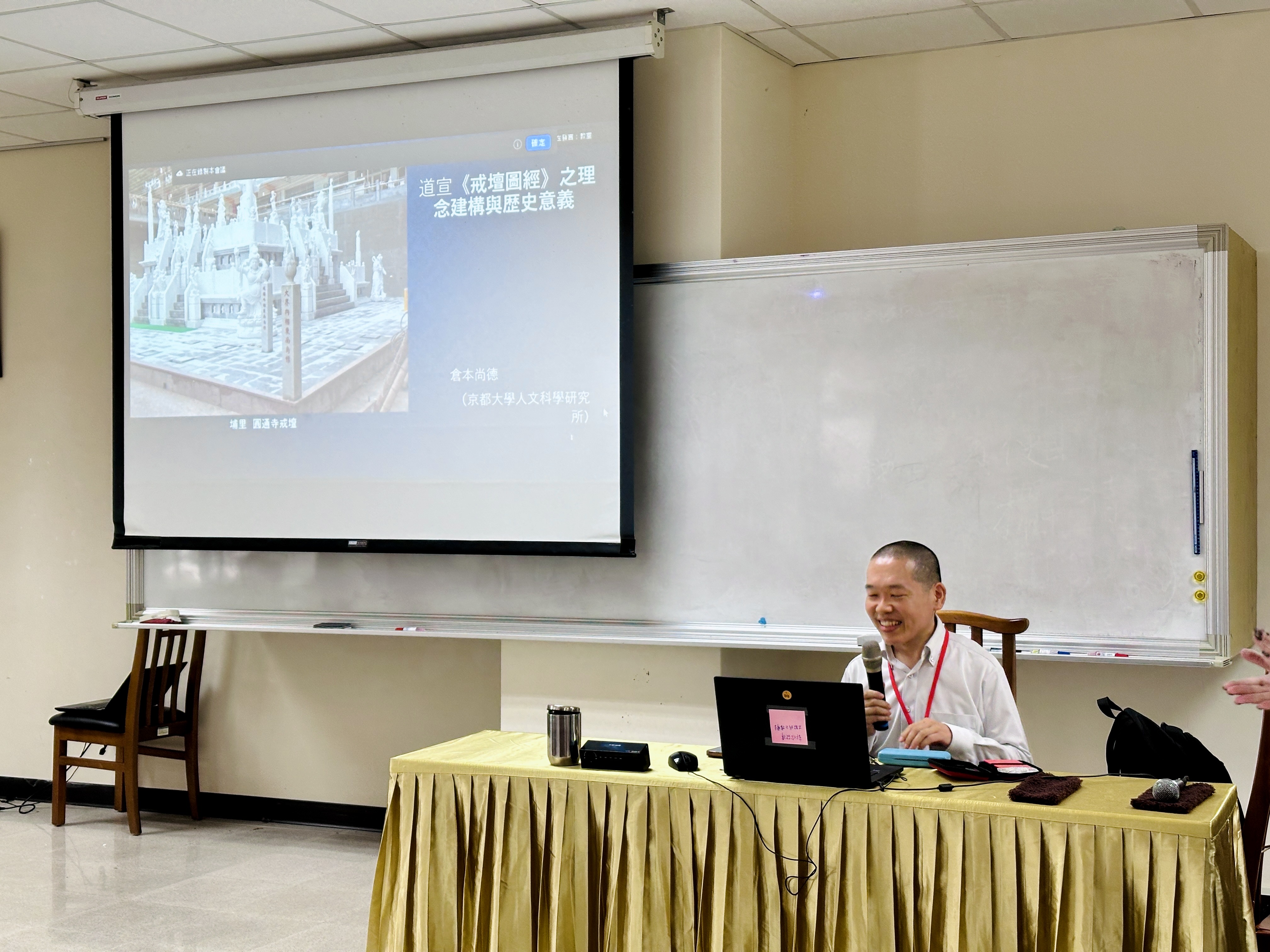
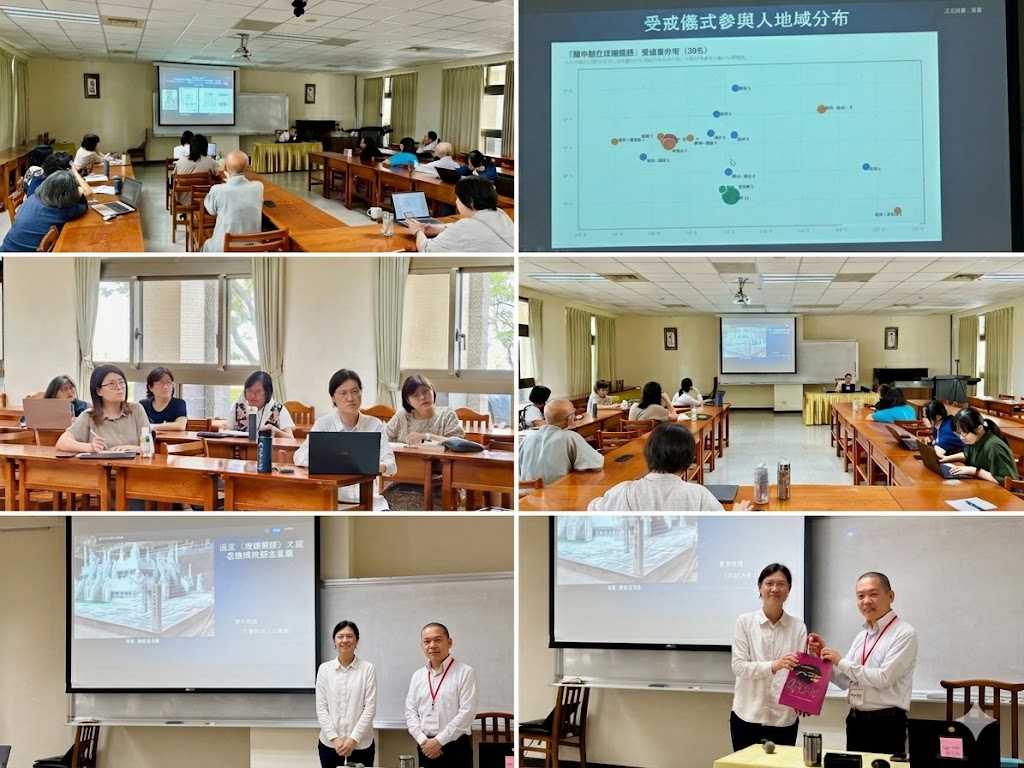
The Center for Buddhist Studies at Fo Guang University hosted a two-day International Distinguished Scholars Lecture Series on June 16–17, 2026, featuring Associate Professor Kuramoto Naotoku from the Institute for Research in Humanities, Kyoto University. Over the course of two lectures, Professor Kuramoto examined two of the eminent Tang Vinaya master Daoxuan’s (596–667) late works: "The Ideological Construction and Historical Significance of the Illustrated Scripture of the Ordination Platform (Jietan Tujing)" and "The Editorial Intentions Behind the Illustrated Scripture of Jetavana Monastery (Qihuan si Tujing)". Drawing on textual transmission, Vinaya practice, monastic architecture, and sacred Buddhist relics, the lectures offered new insights into the formation of Daoxuan's later thought and its broader religious significance.
The first lecture centered on the Jietan Tujing (Illustrated Scripture of the Ordination Platform). Professor Kuramoto explained that the text was composed by Daoxuan in 667 CE, during the final year of his life, and is closely related to several of his other late writings, including the Record of Miraculous Responses Supporting the Dharma, the Biographies of Miraculous Communications Concerning the Vinaya, and the Illustrated Scripture of Jetavana Monastery. Together, these works reveal Daoxuan's concern for the "Abiding Three Jewels" (zhuchi sanbao)—the continued preservation of the Buddha's teachings, sacred objects, and the monastic institution after the Buddha's parinirvāṇa.
Professor Kuramoto emphasized that the Jietan Tujing is far more than a technical manual describing the names, structure, boundaries, and ritual procedures of ordination platforms. Rather, it transforms abstract Buddhist principles into visible sacred architecture and ritual practice. Daoxuan presents the ordination platform as a holy space established according to the Buddha's instructions and constructed by celestial beings. Its three levels symbolize the Three Emptinesses, while the three-tiered structure together with the inverted bowl and jeweled finial represents the Fivefold Dharma Body. The ordination platform also possesses the symbolic qualities of a stūpa, linking the ordination ceremony to the continuing presence of the Buddha and the transmission of the Dharma.
The lecture further explored the ordination rituals described in the text, particularly the practice of circumambulation to the left. Rather than treating this movement merely as a ritual prescription, Daoxuan interpreted it through the cosmic order reflected in the movements of the sun, moon, and stars. Professor Kuramoto argued that Daoxuan thus reinterpreted monastic ritual through a broader cosmological framework. By establishing the ordination platform, Daoxuan also connected the Guanzhong region and the Zhongnan Mountains with the tradition of Buddhist sacred geography, transforming the ordination platform from a site for conferring precepts into a symbol of preserving the Dharma and sustaining the monastic community.
The second lecture shifted attention to the Qihuan si Tujing (Illustrated Scripture of Jetavana Monastery), examining Daoxuan's vision of the ideal monastery during the Buddha's lifetime and the preservation of sacred Buddhist objects after his passing. Professor Kuramoto first reviewed the textual history of the work, noting that although the text disappeared in China, it had already been transmitted to Japan before the ninth century and survives today primarily through Edo-period printed editions. Its preservation demonstrates the importance of transregional transmission in the history of Buddhist literature.
Turning to the monastery itself, Professor Kuramoto explained that the Qihuan si Tujing depicts an immense and intricately layered sacred complex. Buildings such as the Great Buddha Hall, the Eastern and Western Treasure Towers, the Vinaya Ordination Hall, and Mañjuśrī Hall each serve distinct functions, housing numerous stupas, Buddha images, and canonical scriptures inherited from previous Buddhas. The overlapping spatial arrangement evokes the magnificent cosmos described in the Avataṃsaka Sūtra. Professor Kuramoto suggested that Daoxuan's purpose was not to reconstruct the historical Jetavana Monastery, but rather to present an idealized vision of a monastery embodying the enduring presence of the Dharma and the sacred order of Buddhism.
Professor Kuramoto further analyzed Daoxuan's account of the fate of sacred Buddhist objects after Śākyamuni Buddha's parinirvāṇa. According to the Qihuan si Tujing, Buddha images, scriptures, relics, ritual implements, and other sacred objects were entrusted to different realms—including the heavens, the Dragon Palace, and Mount Qingliang—for preservation. In particular, the Dragon King Sāgara plays a central role by safeguarding numerous sacred objects within the Dragon Palace, while Bodhisattva Mañjuśrī transfers important scriptures and relics to the Vajra Cave on Mount Qingliang. Celestial beings, dragon kings, and bodhisattvas thus function as guardians connecting the Buddhas of the past, Śākyamuni Buddha, and the future Buddha Maitreya.
Through this narrative, Daoxuan reconstructed a vision of how the Dharma continues after the Buddha's passing. Sacred objects are not lost with the destruction of monasteries but are temporarily safeguarded by divine protectors until they reappear in the age of the future Buddha. This vision responds to concerns surrounding the age of the decline of the Dharma (mofa) while integrating India's Jetavana Monastery, China's Mount Wutai, the Dragon Palace, and the celestial realms into a unified geography of Buddhist transmission.
Taken together, the two lectures traced Daoxuan's intellectual project from the physical construction of ordination platforms and ordination rituals to the ideal organization of sacred monastic space and the transmission of Buddhist relics. They demonstrated how Daoxuan integrated Vinaya doctrine, miracle narratives, architectural imagination, and sacred geography into a comprehensive system for preserving the Dharma. The lecture series not only deepened participants' understanding of Daoxuan and the Tang Vinaya tradition but also offered fresh perspectives on the interconnected relationships among Buddhist texts, ritual, sacred space, and material culture.