
 Facebook
 Instragram
 College and Department of Buddhist Studies, FGU
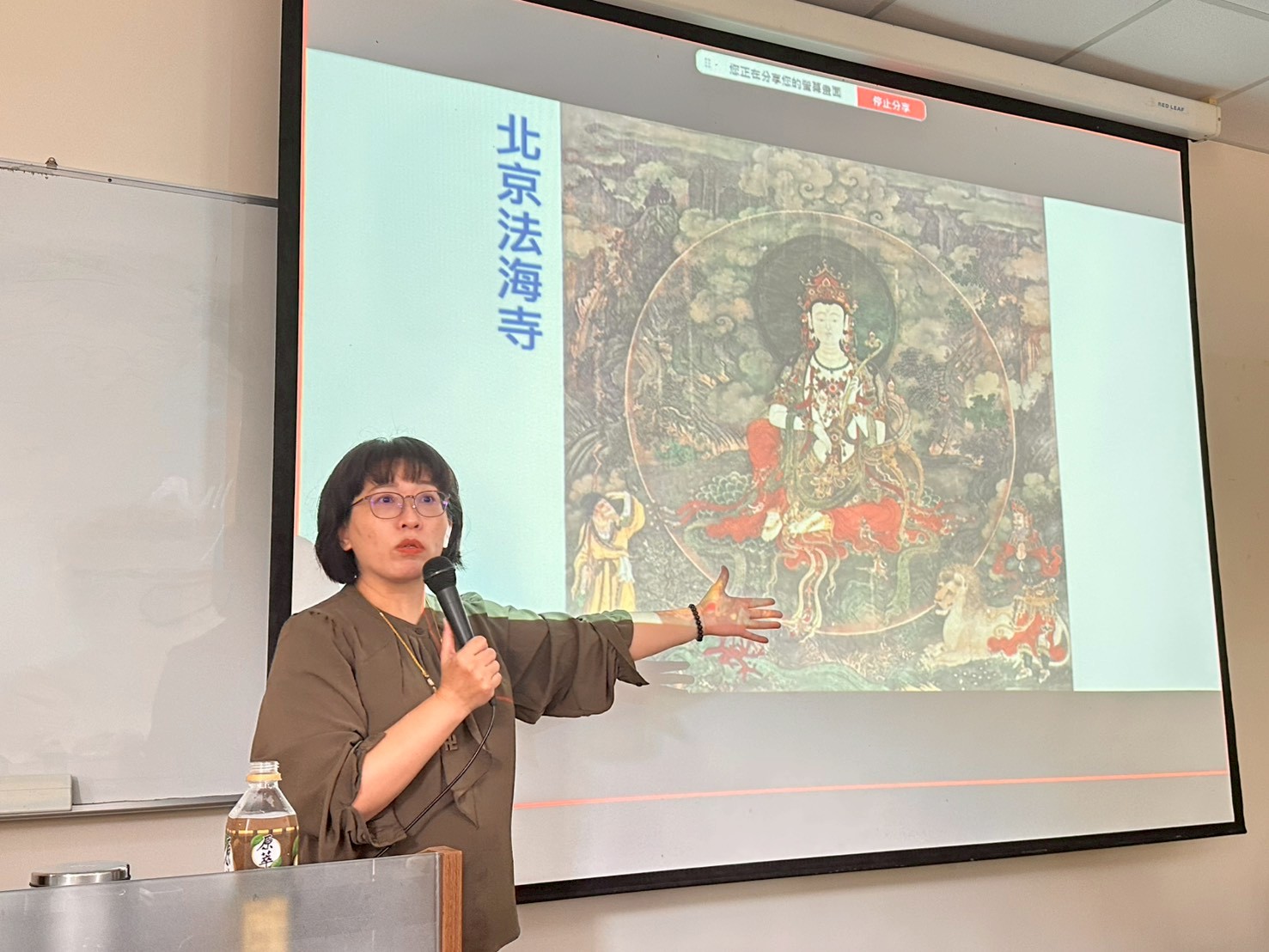
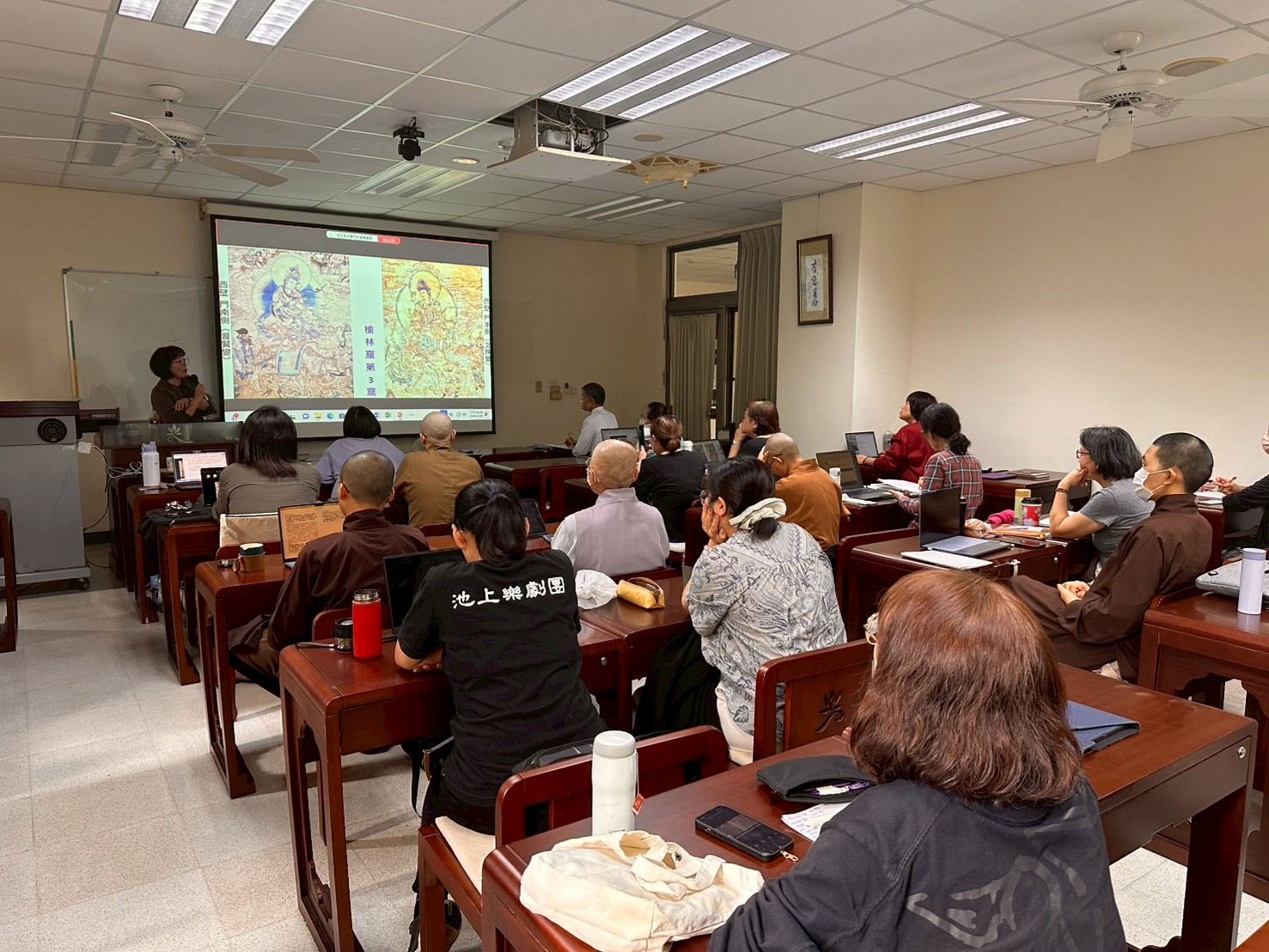
On March 30, 2026, the Center for Buddhist Studies held the first event of its Buddhist Art Lecture Series, titled "Spreading Dharma through Images, Sounds, and Texts in Buddhism," which took place in classroom N202 on campus. The lecture, titled "Clouds and Water Reflecting the Moon: The Origin, Rise, and Fall of Dunhuang's 'Water-Moon Guanyin,'" featured Associate Professor Chien Pei-chi from the Department of Chinese Literature at Providence University as the keynote speaker, attracting a large audience of faculty and students.
Professor Chien Pei-chi pointed out that her academic background combines art history and textual research, emphasizing the mutual interpretation of images and historical documents. At the beginning of the lecture, she used the Bodhisattva images from the Fahai Temple in Beijing as an example to guide students in identifying different Bodhisattva figures, explaining that understanding the formation and classification of images is crucial in the study of iconographic history. Delving further into historical texts, she mentioned that the Tang Dynasty painter Zhou Fang is credited with "marvelously creating the style of the Water-Moon," which marks the origin of the Water-Moon Guanyin iconography. However, she also cautioned that historical records of art often carry a time gap from the era of the figures themselves, requiring researchers to carefully evaluate the credibility of historical sources.
Regarding physical case studies, Professor Chien used the murals in Cave 7 of the Shengshui Temple Grottoes in Weicheng, Sichuan, as well as a silk painting from the eighth year of the Tianfu reign of the Five Dynasties (943 AD)—now housed in the Guimet Museum in France—to illustrate the early appearance of the Water-Moon Guanyin iconography. She also compared these with a work from the second year of the Jianlong reign of the Song Dynasty (961 AD), pointing out that its appearance differs from the styles commonly seen today, thereby proposing the perspective that "Water-Moon Guanyin" might merely be a title for Guanyin rather than a fixed iconographic type.
During the lecture, Professor Chien also emphasized the importance of data organization. By integrating data across different eras, regions, and caves, a clear lineage of iconographic development can be established. She specifically mentioned that the black color commonly seen in Dunhuang murals actually stems from the oxidation of lead-based pigments, rather than being the original color.
Addressing the changes in iconographic forms, Professor Chien analyzed the reasons behind the gradual disappearance of the Water-Moon Guanyin's "large circular body light" (halo), attributing it to the difficulty of preserving certain materials. For instance, the body light is mostly absent in ceramic and wood carving works, and only a few cases remain among gilt-bronze statues, tending to disappear completely after the Ming Dynasty. This demonstrates that iconographic elements evolve alongside mediums and eras.
Furthermore, documents from the Dunhuang Library Cave also provide critical clues. She cited Dunhuang manuscript P.2055, which records individuals in the late Tang and Five Dynasties periods copying the Water-Moon Guanyin Sutra for their deceased wives, as well as a record from the fifth year of the Xiande reign (958 AD) of creating a Water-Moon Guanyin image for the deceased. This led to the inference that this particular iconography might have been closely related to rituals for the salvation of the deceased in the Dunhuang region.